
I was dogsitting for a friend last week and idly rewatched the Jackass movies while reading David Lynch’s memoir Room to Dream. “David Lynch probably would have loved Jackass 3D” was a real thought that crossed my mind during this process, and, by the time credits rolled on Jackass Forever, I’d finished the chapter covering The Straight Story, “the one Disney put out.” Or, to The Criterion Channel, a film starring Harry Dean Stanton.
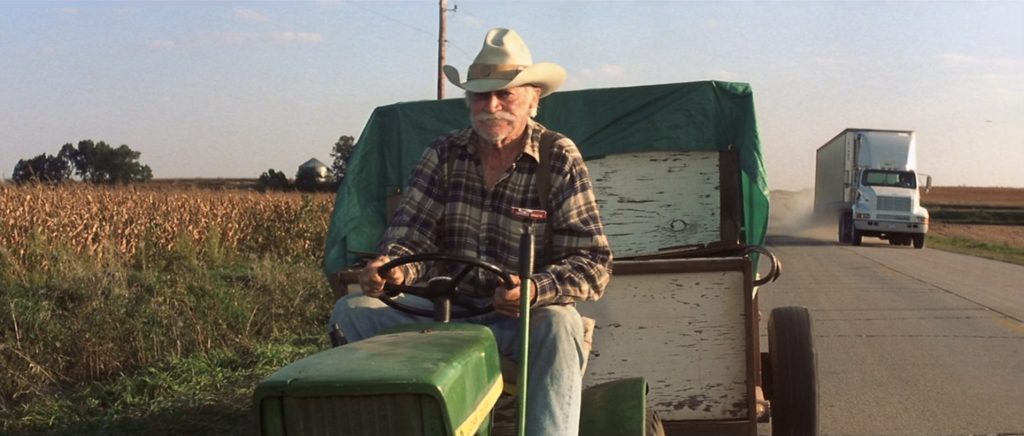
In Room to Dream and elsewhere, Lynch describes The Straight Story as his most experimental work, and, honestly, I can see it. I don’t know how old I was when I figured out that most movies aren’t shot in sequence, but it kind of blew my mind — like, how do you pick which scene, out of dozens, to shoot first? It turns out that there’s an entire universe that goes into decisions like that — in Blue Velvet, for instance, Lynch chose to shoot the Frank Booth/Dorothy Valens sex scene first because he knew it would be the most difficult for both Dennis Hopper and Isabella Rossellini. Where The Straight Story most notably veers from Lynch’s usual method isn’t in its lack of sex and violence, but in the fact that it was shot in sequence, a cinematic retracing of the route Alvin Straight took from Iowa to Wisconsin on his lawnmower.
It’s a beautiful meditation on the middle of nowhere, pocked with Significant Encounters between Straight (Richard Farnsworth) and various strangers — a pregnant runaway, a group of young cyclists, the codgers and recent retirees of a town, all of whom regard his journey with a sense of wonder and stupefaction as they are beholden to his wisdom. This isn’t too far afield for Lynch, frankly — between The Elephant Man and the esoteric zen masters comprising the FBI in Twin Peaks, his characters are happy to wax philosophic — but the risk with this story in particular is that it could have easily become a midwestern Forrest Gump, which is probably what the appeal was to Disney.
Farnsworth is too good for that, anchoring the film with a determined, textured performance, something I imagine was as informed by the real life Straight’s stubbornness as Farnsworth’s own decline — he was terminally ill with prostate cancer during the shooting of the film. He looks beatific and haunted at turns, imbuing the stories he tells with gravitas and the people he meets with dignity. He has regrets, some of them harrowing, and it’s the ghosts of his long life — most of them painfully young — that spur him, mile after long mile, to his brother’s house.
The word “masterpiece” is cornball shit and implies a singular achievement when a career like Lynch’s defies such notions, but you wouldn’t be crazy if you came away from The Straight Story thinking that this qualified. Its surreal touches are brilliant, but what stands out is how awestruck Lynch is by the whole human enterprise, how tenderly he renders its perfect imperfections.
The Straight Story (1999)
Directed By: David Lynch
Screenplay By: John Roach, Mary Sweeney
Cinematography: Freddie Francis
Starring: Richard Farnsworth, Sissy Spacek, Everett McGill, Harry Dean Stanton
Released: October 15, 1999
Watched: July 10, 2026 (Digital)