
My partner came home from a week visiting his folks in Alabama and said he wanted to watch “something fun” and after aimlessly scrolling through stuff on Plex and Max and Criterion we settled on this because I half-remembered having seen it and it having been funny. Turns out what I was recalling was “Cape Feare,” a Sideshow Bob episode of The Simpsons.
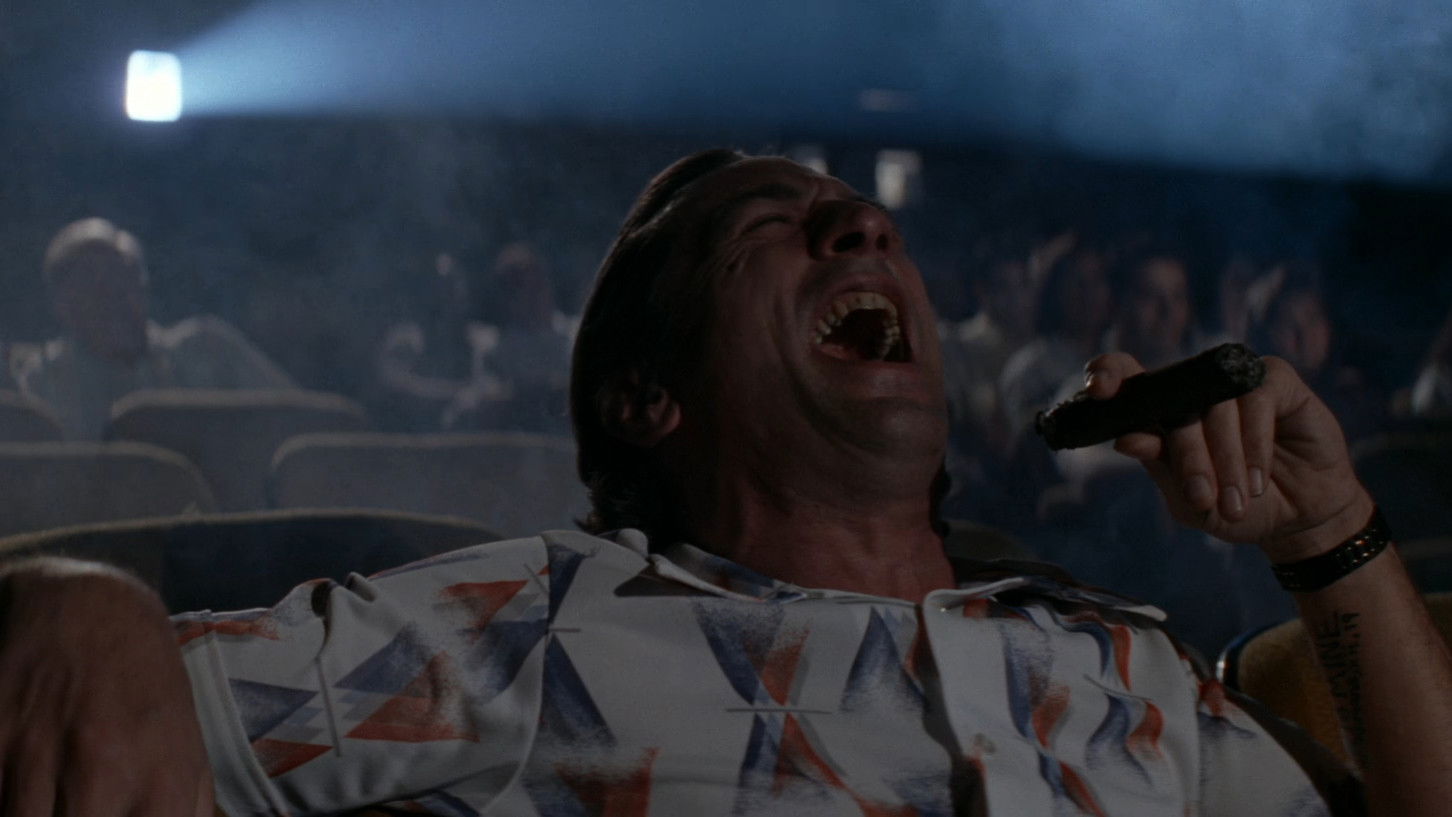
Cape Fear is fun, though. It’s also vulgar and brutal and, like a lot of the poppier beats in Scorsese’s canon, really makes you feel like shit for having a good time with Robert De Niro’s outfits and accent. He’s hillbilly Travis Bickle, honing his body and mind for a singular purpose, but unlike Bickle, who wants to assassinate a senatorial candidate because he’s been swimming in a swamp of racism and misogyny his whole life without knowing it, his Max Cady has been doing pull-ups and hardening his nerves for the sake of torturing and humiliating a yuppie lawyer who, as a public defender some 14 years later, purposefully omitted evidence in a rape case that could have exonerated Cady because he was a) guilty, and b) too dumb, in his estimation, to figure out what had happened.
He’s guilty, but more than learning how to read in prison, he learned how to interpret the law — specifically the ones pertinent to his case and his desire for revenge. He puts himself at the perimeter of his former lawyer’s life, stalking and taunting him by never taking things so far that the police could get involved. Early on in his game he promises Bowden that he’s going to learn what loss is, and before the final showdown on the Bowden family houseboat, he’s right: he’s lost the respect of his peers, the trust of his wife and daughter, the feeling of safety and security afforded to him by his job and class standing, his dog, his sense of justice, and more, reducing him to his base instincts, making him, in some ways, as much of an animal as he perceives Cady as being.
Nick Nolte is tremendous in this role, more grounded than De Niro as he descends into hell, given no hero shots of himself in a sick-ass car or cool clothes or serenely sitting on a fence as 250 years worth of fireworks blow up behind him. He’s in the unenviable moral position of feeling he was right to sell Cady out while knowing he was wrong to do it, which means he’s ultimately unprepared for what’s coming. Were it not for his performance, De Niro’s would be almost too cartoonish — Scorsese absolutely revels in the heat and humidity of North Carolina here, but it’s not like he’s truly going gonzo ala Lynch’s Wild at Heart, which is exists wholly outside the bounds of reality.
My biggest issue with Cape Fear is that, more than most of his films, the women in it largely exist as collateral damage. Jessica Lange, Juliette Lewis, and Illeana Davis are all great in their roles as Bowden’s wife, daughter, and not-quite-mistress, respectively, but Cape Fear being an up-close revenge thriller, there is less space here than in, say, Taxi Driver, whose villain is a stalker and a creep but whose victims could have been any woman because, again, Bickle’s existence is a treatise on societal collapse. There’s no grand ambition here, just slick/sick thrills.
Cape Fear (1991)
Directed By: Martin Scorsese
Screenplay By: Wesley Strick
Cinematography: Freddie Francis
Starring: Robert De Niro, Nick Nolte, Jessica Lange, Juliette Lewis, Joe Don Baker, Illeana Douglas
Released: November 15, 1991
Watched: August 15, 2026