
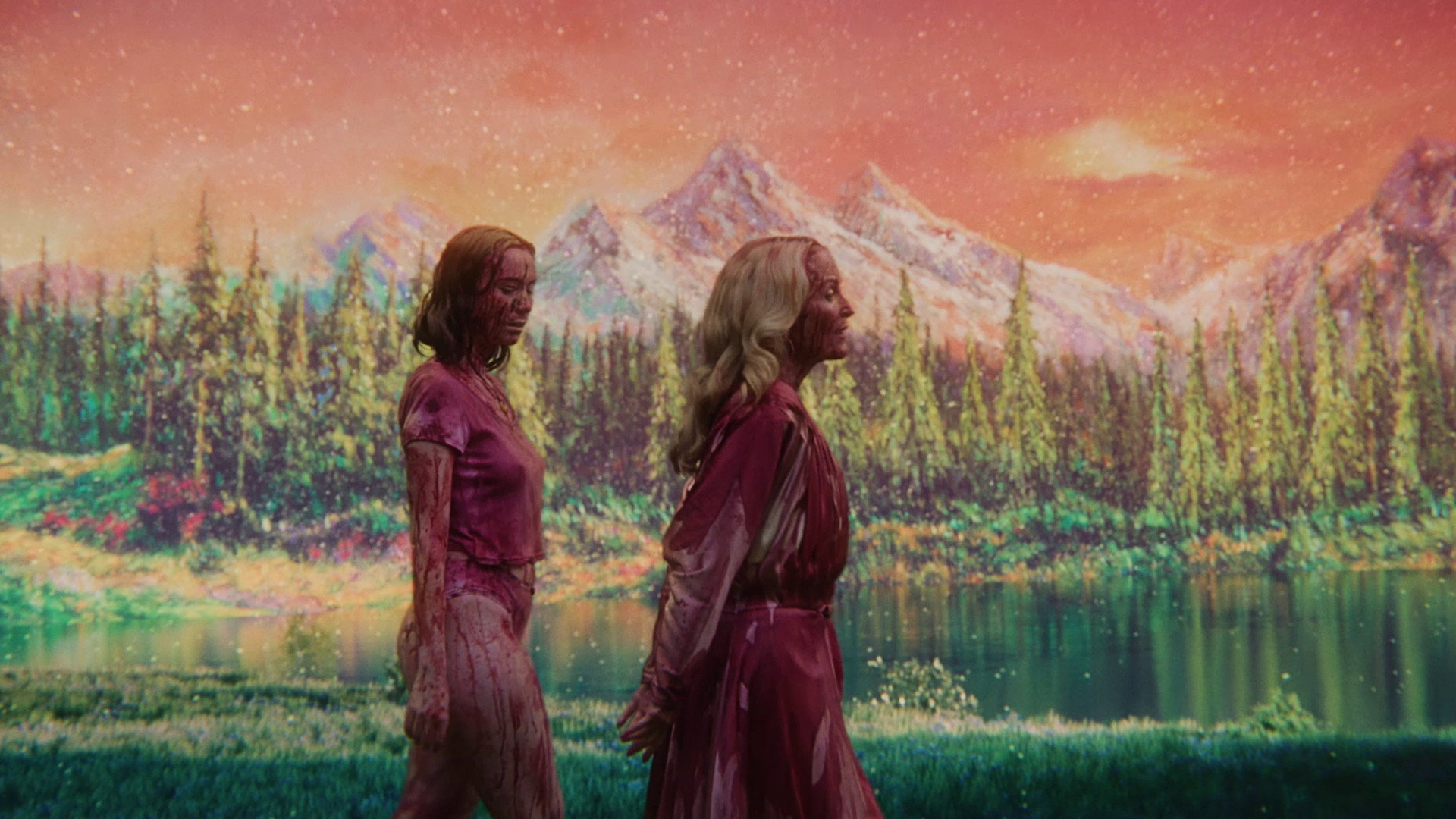
I’ve been struggling for a few weeks now to put how I feel about Teenage Sex and Death at Camp Miasma into words more thoughtful than “I am glad for those to whom this film spoke,” both because that sounds evasive — backhanded, even — and because it is not the whole truth. Like with Jan Schoenbrun’s I Saw the TV Glow, I left Camp Miasma awed by some of its images, annoyed by others, and with the distinct feeling that I was standing on ground I’d already walked before: as a cinephile, a homosexual, a trans woman, etc.
Weeks later, whatever issues I had with Camp Miasma‘s use of pastiche have faded. The heart wants what it wants, and as the author several poems in which I imagine either being hacked to pieces by cinematic serial killers or devoured by TV monsters, there is little in my own artistic work that isn’t excited by (intellectually or sexually) the violent images of others. It’s probably fair to say that I also borrow/outright steal from them at my leisure. Theft can be fun and exciting, and the things built from stolen goods can be better than the original material. I think that is true of Camp Miasma, for the most part. Like, however else I feel about it, sequences like Little Death’s mass killing of camp councillors, mise en scene like the gorgeous matte painting of the forest and mountains surrounding the park, and little embellishments like Louise Weard appearing in a Zoom window as “Queer Assistant” did more for me than most of the material that informed it.
My block, then, is a personal one, the quasi-unfair lens one queer person applies to another’s work when it is unnervingly similar to your own. As the author of a poem titled “Tonight I Want to Play the Victim in the Motion Picture Cruising,” which I wrote and arranged on scans of the soundtrack to the film, wrestling magazines, and a haphazard assortment of my panties in 2016 before it appeared in my long out-of-print collection The Future Is Here and Everything Must Be Destroyed, one of the issues at the heart of Teenage Sex and Death at Camp Miasma — the notion that it would be incredibly hot to be stalked and killed by a shadowy figure at the fringes of a heterosexual man’s imagination of the queer or femme libidinal impulse despite the fact that this desire feels like something of a betrayal of my status as a marginalized person — is one that I’ve thoroughly explored for myself, and, I am quite happy to add, have overcome. It turns out that being hogtied like Al Pacino and left at the mercy of the hogtier is incredibly hot, and I’m not sorry about it.
This left me with another quasi-unfair thought that I think I could only apply to works by other queer/trans white people, which is that I am often more captivated by the work we’re ostensibly trying to reclaim. I’ve been clumsily framing this in my head for a few days now, since speaking to a friend about this compulsion over the phone, but I think I like movies like Cruising or Sleepaway Camp more than I liked Teenage Sex and Death at Camp Miasma is because, while the anxieties of both sides of this coin I’ve invented for myself are existential, the anxiety of the former is, however clumsily, writ large across society, whereas the later is decidedly personal. There’s something thrilling — triumphant, even — about making something like this legible to a mass audience, but there’s more for me to think about in a failed reckoning of the queer person’s place in society, even if I’m doing most of the work for William Friedken when I postulate that Cruising functions as an argument that the homosexual is more deserving of dignity than the police officer.
Again, that’s a clumsy frame, one I’m sure I’ll eventually return to the next time I see the kind of movie that made the Wachowskis make Bound or Schoenbrun make TV Glow and Camp Miasma, or the M. Sisters make Divine Hammer, but until the inevitable day that I do, I guess what I have to say is that Camp Miasma was titillating and frustrating in equal measure. I am, however, truly glad for those to whom this film spoke.
Teenage Sex and Death at Camp Miasma (2026)
Directed By: Jane Schoenbrun
Screenplay By: Jane Schoenbrun
Cinematography: Eric Yue
Starring: Hannah Einbinder, Gillian Anderson, Jack Haven, Patrick Fischler, Kevin McDonald, Sarah Sherman, Dylan Baker, Louise Weard
Released: August 7, 2026