
I am probably the wrong person to say how Zach Cregger’s Resident Evil functions as an adaptation of the video game franchise it shares a name with. I’m a fan of the series, but it’s something I’ve largely watched others play through my fingers, going back to 1998, and my familiarity with its universe and characters was, I think, something I was holding against this film heading into it, to say nothing of how much I enjoy the empty-calorie version of it dreamed up by Paul W.S. Anderson as a charming and fairly convincing argument for his wife as one of cinema’s great badasses.
There are references to images in the video games littered throughout Resident Evil, the shadowy pharmaceutical corporation and the besieged city central to them existing at the periphery of the protagonist’s consciousness, an objective and an obstacle course respectively, but whether or not they spark the pleasure center of the viewer’s brain is immaterial. Resident Evil isn’t an adaptation of the universe, but of the concept of “survival horror” that it popularized. Plunging into the heart of bioengineered terror is a medical courier taking a last-minute job — transporting a priority package to a remote city in the mountains during a snowstorm — because he really doesn’t want to have a difficult conversation with his girlfriend.
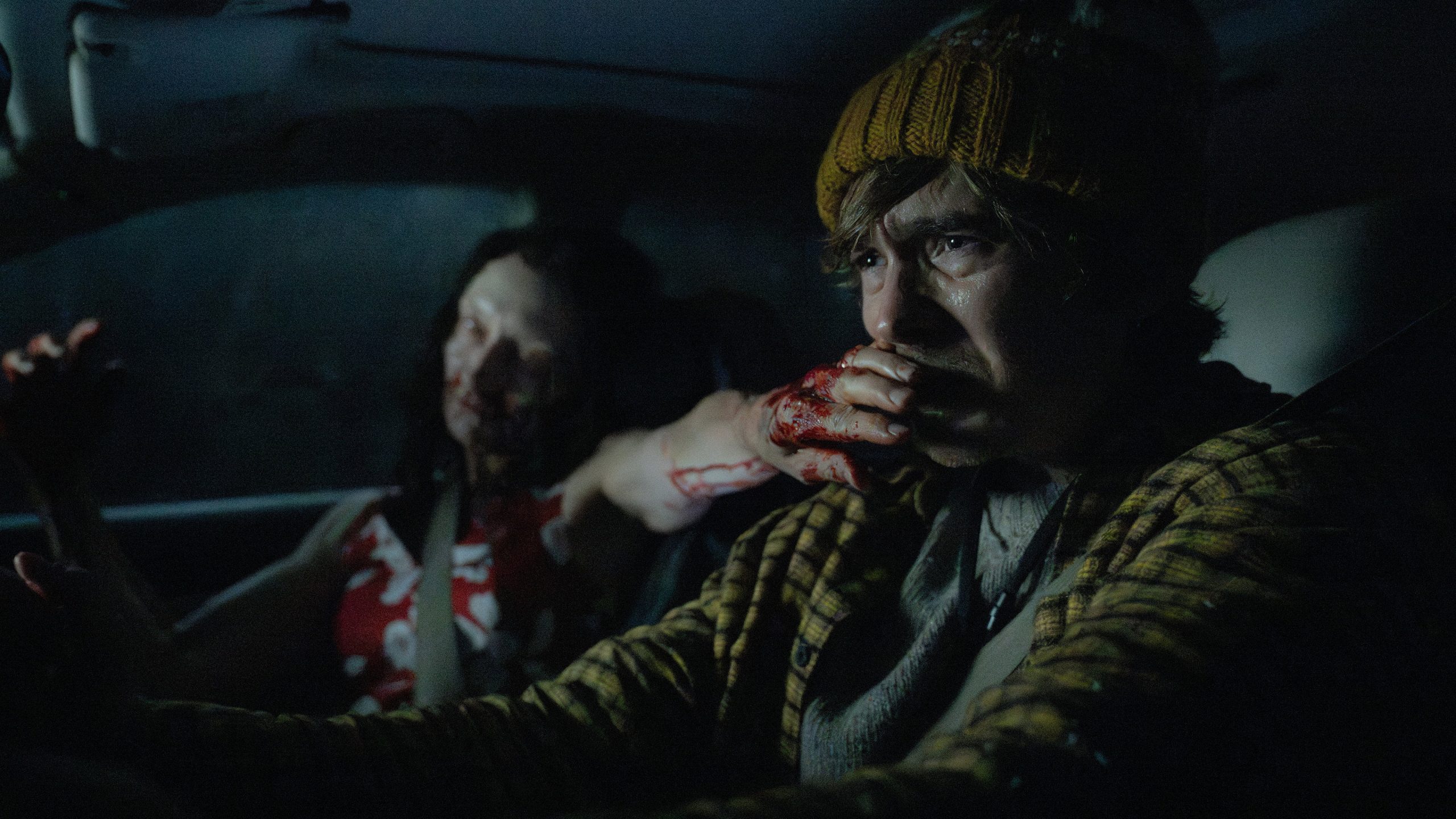
Austin Abrams plays Bryan like a man in over his head before he takes off for Raccoon City, so distracted by the circumstances of the life he’s avoiding that he fails to notice anything strange about the woman he hits with his car until his survival depends on his ability to shoot her with a scavenged gun he doesn’t know how to use. He’s a stammering, stumbling mess of a person, a doomed Coen Brothers neurotic whose tendency to play human carpet nearly gets him killed the first, second, fifth, and fifteenth time Resident Evil tries to kill him, a Raimiesque hero in a world whose heroes tend to be superheroic to the point that they’re less human than the monsters they’ve been purposed with eradicating.
Films have always had an influence on video games, but in the wake of the reception Super Mario Brothers received in 1993, film adaptations of video games largely ignored that influence, opting instead for limp attempts at adapting characters, narrative, and visual beats as closely as possible. Not doing that allows Resident Evil the freedom to riff on the survival horror genre’s inspirations and conventions without feeling derivative. It’s thrilling and funny and gross and horrifying, relentless in its pursuit of scares. Bryan is a survival-allergic dipshit, but he is driven forward, again and again, by cruel twists of fate. Every one of his successes begets failure. Every puzzle he smashes his way through sets him back. But he persists, driven by a Wile E. Coyote-like need to complete the objective.
It brings him no end of misery, and then act one ends and Paul Walter Hauser arrives on the scene for a couple of laughs. I fucking loved Resident Evil until he showed up for comic relief, then I kept loving Resident Evil, just a little bit less. The film is so exacting in escalating the pace and stakes, so good at keeping the MacGuffin and its courier in motion, and so ruthless in twisting the knife in his back that Hauser’s blowhard Umbrella employee feels like a means of cheating the film out of the brutal corner it’d painted itself into: this isn’t just survival horror, it’s survival horror-comedy.
It’s deflating, but only a little. The big action sequences and twisted little freaks that fill the screen are a fucking blast, a mix of good practical effects and good-enough CGI that feels like Cregger cracking the code that eluded the filmmakers who helmed the popcorn monster apocalypses of the late-00s to mid-10s. In movies like Francis Lawrence’s I Am Legend and Marc Forster’s World War Z, the horror of an undead horde is lost in the scale of it on screen, an infinite wave of CGI bodies crashing against the bulwark of humanity’s final few, all of whom are suspiciously handsome and capable with guns. These films didn’t work, despite the resources at their disposal, because they were lying to themselves about what they were: in failing to make morality plays about the failures of society, they authored tepid power fantasies penned with infinite ammo.
Resident Evil doesn’t play that game. It’s playing Resident Evil. There’s a fucked up house, a fucked up city, and a fucked up research facility, everything between those three places is fucked up, and there are more monsters than there are bullets. The fantasy of the video game is that there is an elite force of globe-trotting cops so skilled in navigating this hell that the world goes on mostly not knowing how close it it came/continues to be in danger of a bioengineered apocalypse. It’s thrilling because you are the globe-trotting cop, because it is your sense of control over the situation that is constantly being challenged.
“What if the hero sucked at guns” is a great question to ask when adapting that idea to a medium over which the audience has no control whatsoever. The scale of the horde isn’t what matters, but the sense of being utterly, horribly alone, in terrible danger, and prone to beefing it under stress. It isn’t particularly deep, but neither are the games. They are machines engineered to deliver grotesque, thrilling spectacle — the lore is ancillary. The same is true of this movie — the lore is there, but the film is framed so tightly on Bryan that it registers as an inconvenience to him, one obstacle among hundreds costing him precious seconds on a clock he can’t see but knows is ticking. He has to deliver his package to the hospital. Someone needs it. Someone has to sign for it. He has to survive — with respect to the gaping maw of tentacles and teeth at his heels, that’s the horror.
Resident Evil (2026)
Directed by: Zach Cregger
Screenplay by: Zach Cregger, Shay Hatten
Cinematography: Dariusz Wolski
Starring: Austin Abrams, Zach Cherry, Kali Reis, Paul Walter Hauser
Released: September 17, 2026