
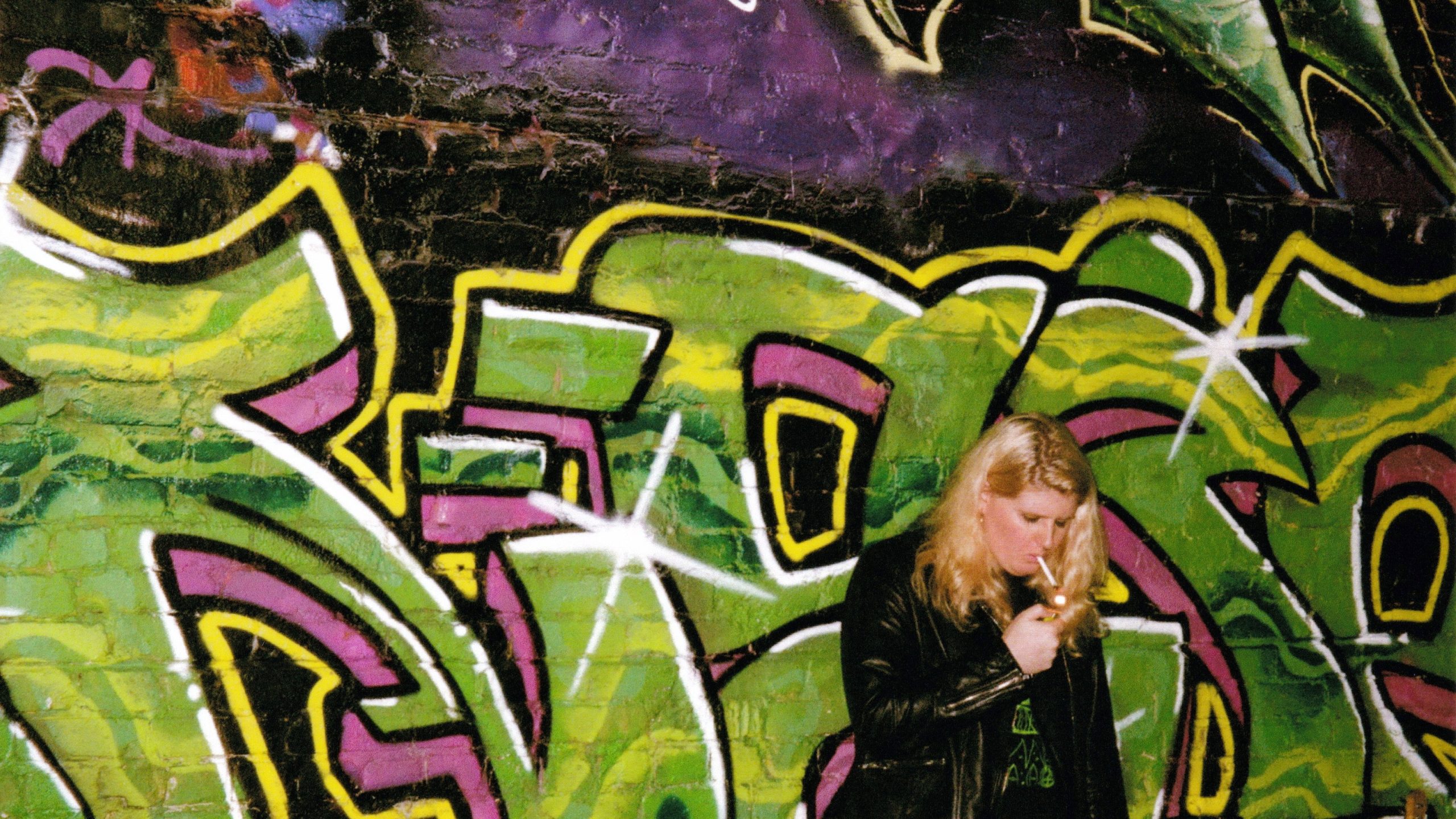
Full disclosure: I booked a screening of this film for Triangle Queer Film, a new(ish) group that screens queer movies around the NC Triangle, if you can believe it. This was our second outing, following the North Carolina premiere of Divine Hammer, and the first we screened in a movie theater, the Chelsea in Chapel Hill. Until the day I grow tired of the thrill of booking queer movies so that a couple dozen people can watch and talk about ’em, every TQF screening is going to be five stars.
That said, I do not think I would have survived Louise Weard’s Castration Movie Anthology i. Traps had I tried watching it alone on a screen any smaller than the one at the Chelsea. This has nothing to do with the film’s length. It’s too intimate, too grim, too crushingly sad to be borne alone, which is the state its disparate, desperate characters find themselves in, even when they’re in a crowded room.
Characters aside, there is no bottom here, and I cannot imagine many/any of its characters — chief among them Michaela “Traps” Sinclair (Weard), her recently transitioned friend Adeline (Aoife Josie Clements), and Turner (Noah Baker) — finding it in either the 2025 or 2026 chapters of Castration Movie, or if that’s even the point. Here, you’re asked to linger as Michaela, Adeline, and Turner’s lives spin out of control. Michaela and Adeline’s narratives are closely intertwined, but Turner’s, which plays out in “Chapter 1: Incel Superman,” makes a brief visitation via two chance encounters.
What unites Michaela and Turner is that both are chronically online and terminally alone, both of them ironically doomscrolling 4chan imageboards that they believe themselves to be above despite the fact that they’ve both swallowed the site’s poison pill. Turner, stuck in a dead-end job and believing himself to be an artist, destroys his relationship and his career, blaming it on his girlfriend and boss, terrorizing his girlfriend, and seeking refuge amongst the incels he once mocked.
Michaela’s arc is more subtle. She’s a sex worker who has a friendly social circle, a boyfriend, and a family she’s still in contact with. She is well-armored against a world that is, at best, antagonistic towards trans women, but there are holes in that armor, many of which are drawn painfully from common trans experiences: her boyfriend is a discreet chaser, her dysphoria is rooted in hypermedicalized and largely discredited theories about transgender people, and she will not stop dispensing unasked for advice to Adeline, stage mothering her transition as if the success or failure of it was a reflection of her own character.
It all goes to shit. Because this part of the film is 3/4 of an over four-hour affair, you really sit with Traps as it does so, its minutiae, if not the uneven handheld DV cinematography, in the spirit of Jeanne Dielman. I kind of hated being under Castration Movie‘s gaze for as long as I was, not because it recalled any headspace I’ve been in, but because it did thrust me, uncomfortably, into many rooms, group chats, and random encounters I’ve been in and had over the course of my life, and I could feel myself freezing up/squirming on the inside the closer Traps pilots her life towards the abyss.
Something I’ve seen a lot as it relates to this movie, even in discussions within TQF about what films we’re hoping to screen, is that Castration Movie is, for lack of a better way of putting it, extremely white. Given that the film deals with people who find themselves circling the drain of white nationalist thought, that feels intentional. In their respective fugue states, they barely leave the house for anything that isn’t work- or stimulant-motivated, and the internet permeates every second of their lives, even when they’re not looking at their phone. Does Traps know any people of color? Does Turner interact with any at the film set on his job? Probably, but their worlds are so narrow when we encounter them that there’s hardly any room for the people who care for/tolerate them to breathe, let alone the wider world of Vancouver, the victims of a long-running plot to turn isolated, lonely people into frothing bigots.
What’s uncomfortable about Castration Movie is that it asks the viewer for the grace to see those people — Traps in particular — as victims. On an Instagram post promoting the screening, someone said that they wanted to see the film but likely would not on account of needing to see “queer joy” in the world in this moment. I don’t know what “queer joy” is, at least writ large, but there is a lot of joy around Traps — a friend’s top surgery, a polycule’s ceaseless makeout session, the music Adeline makes with her partner, pizza and cigarettes over a screening of The Angry Video Game Nerd Movie — in all of this, in the fabric of her life, there is the potential for joy, depressed or not. Traps’ issue isn’t that she believes herself to be better than the life she’s struggled to put together — she is, all of us are — but that she feels like she’s owed an easy way out of it and has not thought of what to do when those doors slam shut in her face. You want to feel for her. You want her to feel. It’s an incredibly well-drawn portrait of a woman in trouble. How deep that trouble runs is a question I almost can’t bear the answer to.
Castration Movie Anthology i. Traps (2024)
Directed by: Louise Weard
Screenplay by: Louise Weard
Cinematography: Louise Weard, Dakota Blais, Aoife Josie Clements, Avalon Fast, Joshua Gratton, Jasmine Provins
Starring: Louise Weard, Aoife Josie Clements, Noah Baker, Jasmine Provins, Vera Drew, Alice Maio Mackay, Magda Baker, Cameron Petersen
Released: November 16, 2024